
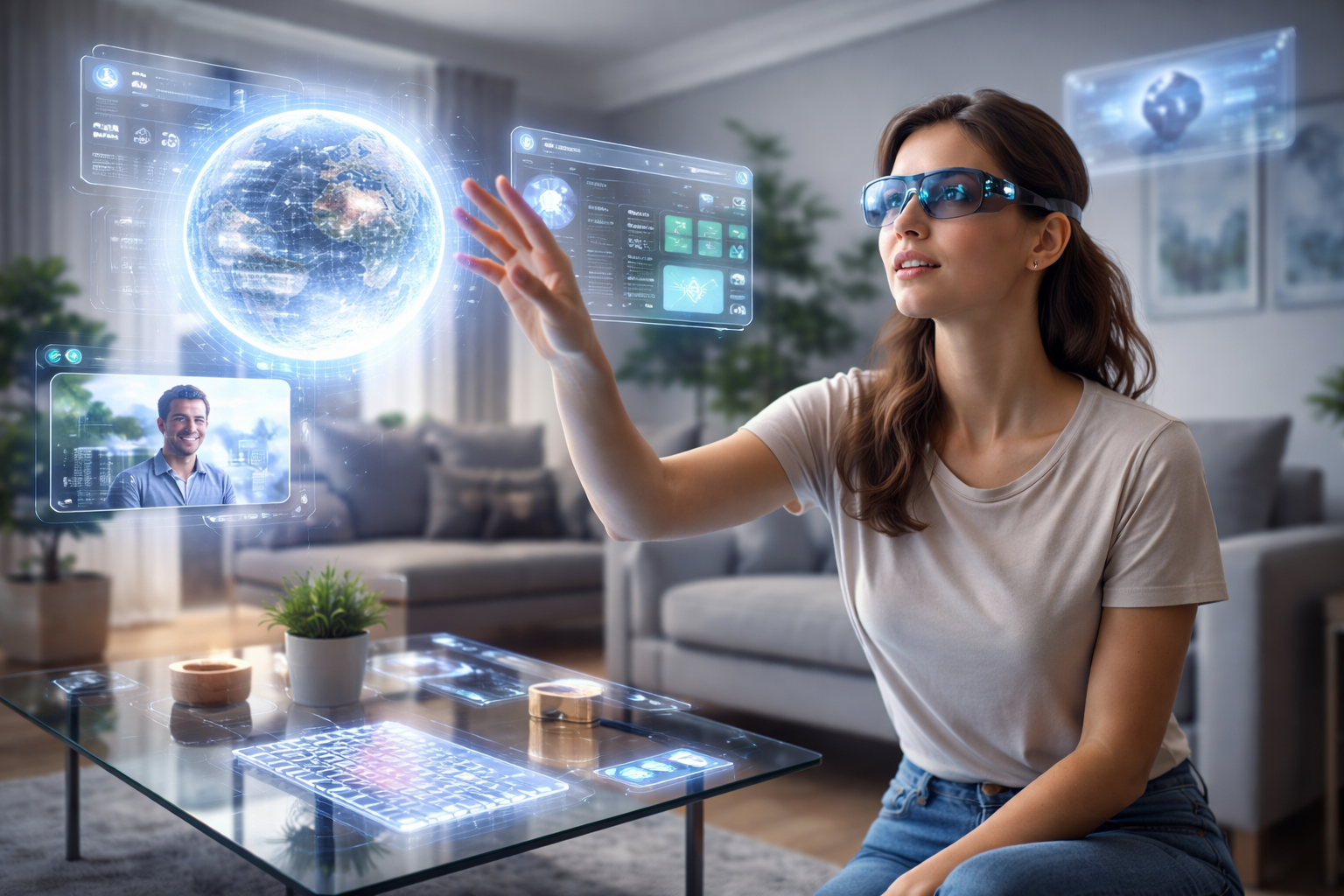
Take a moment to look around. Screens are everywhere. On desks, in pockets, on walls and even on wrists. For decades they have been the primary way we interact with technology. But what if the future is not about better screens, but no screens at all?
It might sound far fetched, but the way we interact with technology is already starting to shift. The next generation of interfaces is moving beyond flat displays and into something far more immersive, intuitive and seamless.
Beyond the rectangle
Traditional screens are limited. They require our full attention, they fix information into a small space and they force us to interact in very specific ways. New technologies are breaking those constraints.
Wearable displays are one of the first steps. Smart glasses are already capable of overlaying information directly into your field of vision. Directions, notifications and data can appear exactly where you need them, without looking down at a device. It is a small shift, but a powerful one.
Then there are projected interfaces. Imagine a keyboard appearing on your desk or a dashboard projected onto a wall, ready to interact with. No physical screen, no fixed device, just information where you need it when you need it.
The rise of spatial computing
Perhaps the most exciting development is spatial computing. Instead of interacting with a screen, you interact with digital elements in the space around you. Data is no longer confined to a display. It lives in your environment.
You could walk around a 3D model, pull information closer with a gesture or expand a dashboard across an entire room. Meetings could take place around virtual objects rather than shared screens. Work becomes something you move through, not something you look at.
More natural, more human
The biggest advantage of moving beyond screens is how natural it feels. Voice, gesture and even eye movement are becoming ways to control technology. These interactions remove friction and allow people to stay focused on the task rather than the tool.
Instead of stopping to check a device, information comes to you. Instead of tapping through menus, you simply interact with what you see.
Challenges still remain
Of course, this future is not fully here yet. Wearable devices need to become lighter and more comfortable. Battery life and processing power must improve. Privacy is also a key concern as devices become more integrated into daily life.
But the direction is clear. Technology is becoming less about the device and more about the experience.
A world without screens?
Will screens disappear completely? Probably not. They will still have a place in certain tasks and environments. But their role will change.
Instead of being the centre of our digital lives, screens may become just one option among many. The real shift is toward interfaces that adapt to us, not the other way around.
The future is not about staring at screens. It is about interacting with technology in a way that feels effortless, natural and almost invisible.
And that future might be closer than we think.


