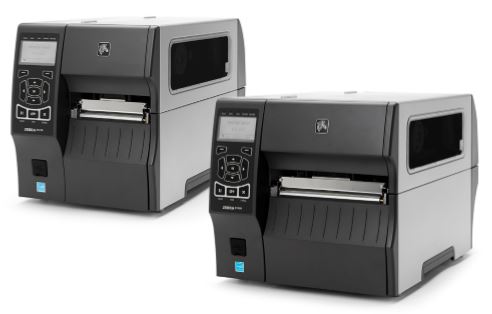
Industrial barcode printers are built for environments where a desktop model would wear out within weeks. The defining characteristics are a high-duty-cycle mechanism, metal frame construction, wider media capacity and the ability to run continuously across multiple shifts. Where a desktop printer handles a few hundred labels per day, an industrial unit is rated for thousands.
They’re the standard in warehouses, manufacturing plants, transport and logistics operations and anywhere compliance labelling runs at volume. The construction reflects that purpose. Industrial printers handle wider and heavier media, survive factory conditions and connect directly to warehouse management systems and ERP platforms via ethernet and standard printer languages like ZPL.
Gamma Solutions helps businesses select, deploy and support industrial barcode printing solutions built for demanding warehouse and manufacturing environments. With more than 30 years working across Australian supply chains, we focus on matching the right printer to your throughput, environment and integration setup, then keeping it running through ongoing service and on-site support.
How We Help You Choose the Right Industrial Printer
The wrong industrial printer is an expensive mistake. Underspecify and you’ll be servicing the unit constantly while the production line waits. Overspecify and you’ve paid for capacity you’ll never use. Our team works through your operation with you, covering the inputs that actually affect performance and total cost of ownership.
- Daily and peak print volumes across single or multi-shift operation
- Media width, label material and ribbon requirements
- Environmental conditions, dust, temperature swings, wash-down or cold storage
- Integration with WMS, ERP, MES or production line software
- Service coverage and response times to minimise downtime
That conversation usually saves more than the printer costs, because choosing the right unit upfront avoids unplanned servicing and lost throughput later. After delivery, we handle installation, configuration and integration so the printer is producing usable labels from day one.
When You Need an Industrial Printer, Not a Desktop
The clearest signal is print volume. Industrial printers are designed for continuous-duty operation, typically 1,000 or more labels per day, with many rated for multi-shift or 24/7 use. If your production line or warehouse runs at that throughput, a desktop model will fall behind, wear out faster than it should and force unplanned downtime to swap out hardware.
Media width is another differentiator. Most desktop printers cap at 4 inches. Industrial models handle 4 inches as a baseline, with many going to 6 or 8 inches for pallet labels, carton labels and other large-format applications.
Ribbon capacity matters on a production line. Industrial printers use larger ribbon cores, which means fewer ribbon changes and less downtime. On a fast-moving line where stopping to swap a ribbon costs real money, that difference adds up over a shift.
The build itself sets industrial printers apart. Metal frames, dust and moisture resistance, and components rated for factory conditions rather than office environments. These aren’t desk units running at higher speed. They’re a different category of machine, built to survive the environment they sit in.
Integration is the final consideration. Industrial printers support RS-232, parallel and ethernet connections, and most speak ZPL, EPL or comparable printer languages. That makes integration with warehouse management systems, ERP platforms and production software straightforward, especially when the deployment is planned from the start.
Industries We Supply
Warehousing and Distribution
Warehouses and distribution centres use industrial printers for pallet labels, carton labels and compliance labelling to GS1 and logistics standards. High daily volumes, varied label sizes and the need for network-connected printing are standard requirements. The right setup keeps throughput predictable across shifts and reduces the operational interruptions that come from a printer failing mid-shift.
Manufacturing
Manufacturers use industrial printers for work-in-progress labels, component traceability and production line labelling. Print runs need to keep pace with a moving line, and label durability matters when stock moves through multiple production stages. We help manufacturers specify printers that handle the line speed and label material requirements without becoming a bottleneck.
Transport and Logistics
Consignment labels, dangerous goods labels and freight compliance labels require consistent, high-volume printing. Thermal transfer is typically the right choice here, given that labels need to stay legible through handling, weather and transit. Reliability matters most when a missed label means a missed dispatch window.
Government and Utilities
Asset management, compliance labelling and field labelling often require durable labels printed in non-standard environments. Industrial printers handle the media types and print volumes these applications demand, and we work with public sector teams on procurement, deployment and long-term service requirements.
Zebra and Honeywell: Which Brand Suits Your Environment?
Brand choice depends on your software stack, environment and the service network you need behind the deployment. We work with Zebra and Honeywell because both are proven in Australian industrial environments and backed by parts and service networks that keep downtime low.
Zebra
Zebra’s industrial range, led by the ZT series, is the benchmark in Australian warehousing and logistics. ZPL is the most widely supported printer language in WMS and ERP software, which makes Zebra printers straightforward to integrate. They’re built to run hard and are backed by a strong service and parts network in Australia.
Honeywell
Honeywell’s PM and PX series industrial printers suit manufacturing and healthcare environments where print quality needs to stay consistent over long runs. They handle a wide range of media types and ribbon configurations, and are built for demanding applications.
Beyond the Printer: Long-Term Support and Partnership
Industrial barcode printing rarely lives in isolation. It connects to a WMS, drives compliance labelling, feeds production data and sits inside a broader supply chain setup. Hardware that’s right for the job, and a deployment that integrates cleanly with everything else, is what keeps throughput steady.
Gamma Solutions handles end-to-end deployment, from site assessment and printer specification through to installation, software integration and ongoing service. Once a printer is in place, we stay involved with media supply, servicing, firmware updates and the small adjustments that keep multi-shift operations running. When your needs change, scaling up to additional units or new locations doesn’t mean starting over.
That long-term partnership is what Gamma is built around. Real-world operational impact for warehouses, manufacturers and supply chain teams that need their hardware to keep running, shift after shift.
Book a printer specification call with our team
Frequently Asked Questions
What’s the difference between an industrial and a desktop barcode printer?
Industrial printers are built for high-volume, continuous use. They have heavier construction, higher duty cycles, wider media capacity and better integration options than desktop models. Desktop printers suit low-to-medium volumes. Industrial printers are the right call when daily volumes consistently exceed 1,000 labels or when the printer needs to run across multiple shifts.
How do I know if my print volume justifies an industrial printer?
If you’re consistently printing more than 1,000 labels per day, or running across multiple shifts, an industrial printer is the practical choice. Pushing a desktop model beyond its rated duty cycle leads to faster wear, more frequent servicing and the kind of unplanned downtime that costs more than the upgrade. Our team can help you map your volumes to the right model.
Can industrial barcode printers be integrated with warehouse management systems (WMS)?
Yes. Most industrial printers support ethernet connectivity and speak ZPL, EPL or similar printer languages, which makes integration with WMS, ERP and production software straightforward. Gamma Solutions handles the integration setup as part of the deployment so the printer is talking to your systems from day one.
What print width do I need for pallet or carton labels?
Pallet labels are typically 4 x 6 inches, so you need a printer with at least a 4-inch media width. Carton labels vary but often require the same. Some applications use larger formats, in which case a printer with 6 or 8-inch capacity may be necessary.
How often do ribbons need to be replaced on an industrial printer?
Ribbon life depends on print volume, label coverage and the ribbon length loaded. Industrial printers use larger ribbon cores than desktop models, so changes are less frequent. In a high-volume environment, you might change a ribbon every few days rather than multiple times per day, which keeps unplanned stops on the production line to a minimum.
Do industrial barcode printers work in cold storage or outdoor environments?
Some models are rated for cold storage or outdoor use, but not all. Check the operating temperature range before specifying a printer for a cold-chain environment. Gamma Solutions can confirm which models suit these conditions and recommend the right setup for the environment.
What brands of industrial barcode printers does Gamma Solutions stock?
Gamma Solutions stocks industrial printers from Zebra and Honeywell, and supports them with deployment, integration and ongoing service.
Do you provide installation, setup, or on-site support for industrial printers?
Yes. Gamma Solutions provides installation, configuration support and on-site help for industrial printer deployments. Multi-shift environments rely on reliable hardware, and our service coverage is built around keeping that hardware running so your operation isn’t waiting on a fix.