
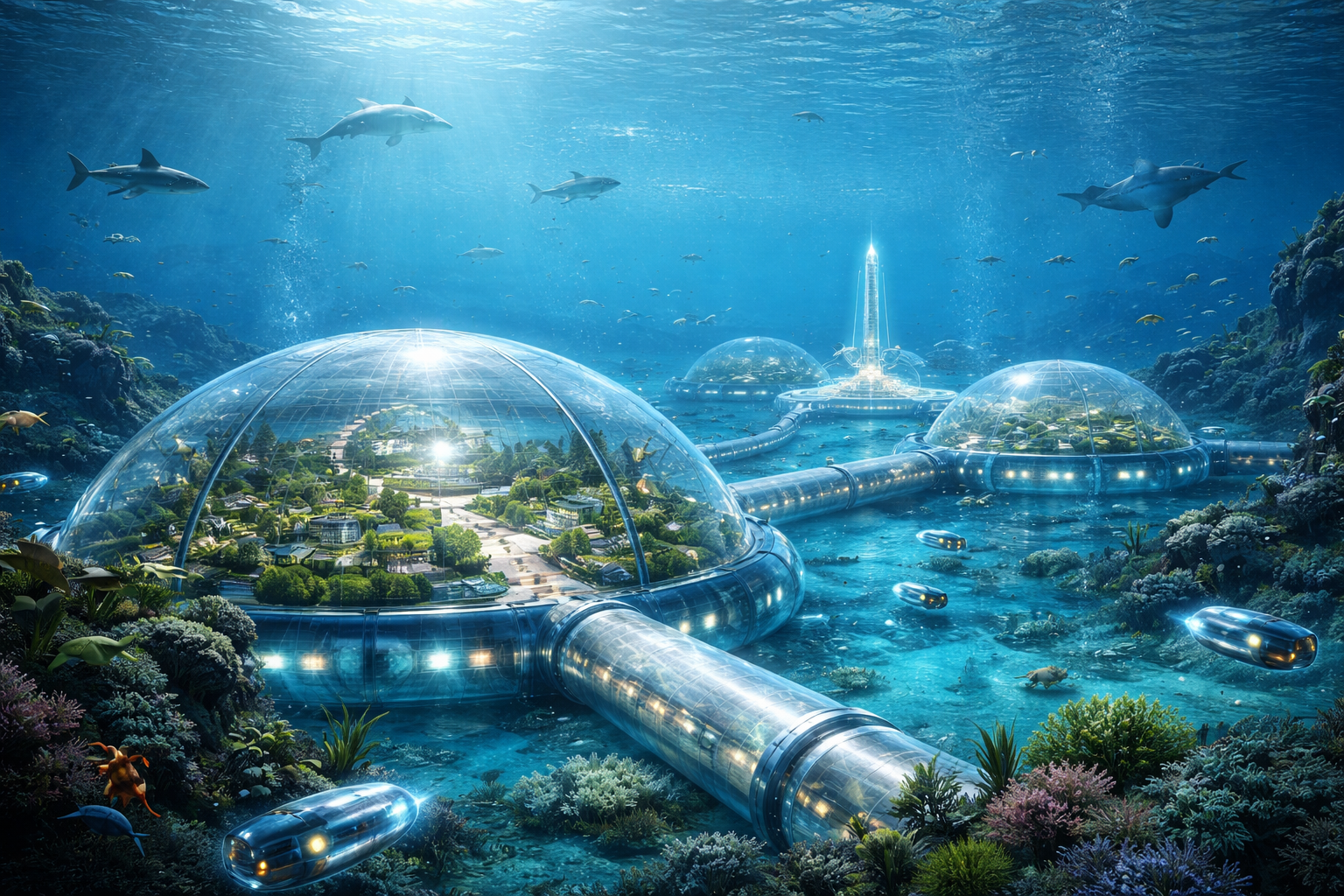
As cities continue to grow and space becomes more limited, architects and scientists are looking in an unexpected direction for the future of urban living. Not up into the sky, but down beneath the ocean. What was once the domain of science fiction is now becoming a serious area of research and innovation.
Imagine stepping out of your home and into a world surrounded by marine life. Glass domes reveal schools of fish moving through crystal clear water. Natural light filters down from the surface above. Entire communities operate below sea level, powered by renewable energy and designed to coexist with the ocean rather than compete with it.
Why underwater?
With rising populations and increasing pressure on land resources, the ocean presents a vast and largely untapped frontier. Over seventy percent of the Earth’s surface is covered by water, yet very little of it is used for permanent human habitation.
Underwater cities could help reduce urban congestion, support new industries and open up new possibilities for sustainable living. Coastal regions in particular stand to benefit, with the potential for offshore habitats that extend cities beyond traditional boundaries.
How would it work?
Designing underwater habitats comes with unique challenges. Structures must withstand pressure, corrosion and constant exposure to saltwater. Engineers are exploring materials that are strong, flexible and resistant to long term wear.
Many concepts feature modular designs, allowing sections of a city to be built and expanded over time. Transparent materials would provide natural light while advanced filtration systems maintain air and water quality. Renewable energy sources such as tidal and wave power could provide a steady supply of electricity.
Inside, life would feel surprisingly familiar. Living spaces, workplaces and communal areas would be designed for comfort and functionality, with technology seamlessly integrated into daily life.
Sustainability at the core
One of the most exciting aspects of underwater cities is their potential to support sustainable living. These environments could be designed to operate with minimal waste, recycling water and materials efficiently. Food production could include underwater farming and aquaculture, reducing reliance on traditional supply chains.
By building with the ocean rather than against it, these habitats could also support marine ecosystems, creating artificial reefs that encourage biodiversity.
The challenges ahead
Despite the promise, there are still significant hurdles to overcome. The cost of construction is high, and long term maintenance presents ongoing challenges. Human adaptation to living underwater is another factor, both physically and psychologically.
Safety is also critical. Systems must be designed to handle emergencies such as leaks or power failures, with reliable evacuation and support mechanisms in place.
A glimpse into tomorrow
While fully realised underwater cities may still be years away, smaller scale projects are already underway. Research stations, underwater hotels and experimental habitats are providing valuable insights into how people can live and work beneath the ocean.
As technology advances and the demand for new living spaces grows, the idea of underwater cities is becoming more realistic. It represents a bold shift in how we think about urban environments and our relationship with the planet.
The future of cities may not just expand outward or upward. It may dive beneath the surface, opening up an entirely new world of possibilities.


