
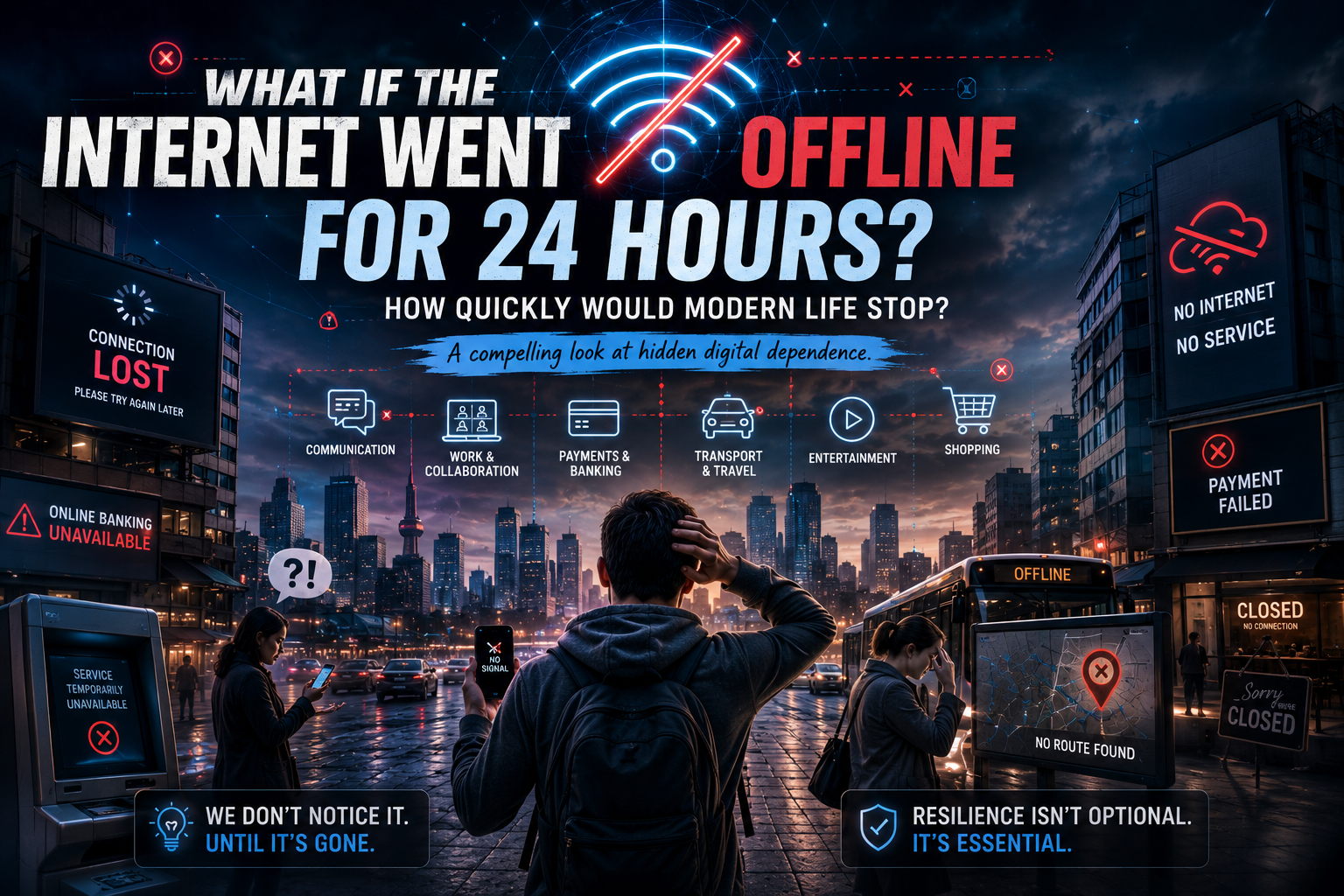
How Quickly Would Modern Life Stop?
Imagine waking up tomorrow morning and discovering that the internet has disappeared.
Your phone has no signal. Emails are not coming through. Online banking is unavailable. Streaming services refuse to load. Navigation apps are blank and social media feeds have fallen silent. At first, it might feel like a minor inconvenience. Perhaps an outage with your internet provider. Maybe your Wi-Fi router needs a restart.
Then the reality begins to sink in.
The internet is not just something we use. It is something we rely on. In fact, it has quietly become one of the most important pieces of infrastructure in modern society, sitting alongside electricity, water and transport. The difference is that most of us rarely think about it because it is almost always there.
But what would actually happen if the entire internet went offline for just 24 hours? The answer is both fascinating and slightly terrifying.
The First Hour: Mild Panic
The first few minutes would probably be filled with confusion. People would instinctively reach for their phones, refresh their browsers and restart their devices. Offices would assume there had been a local network issue. Coffee shops would apologise for their Wi-Fi being down.
Within an hour, however, the scale of the problem would become clear. Messaging platforms would stop working. Video meetings would disappear. Cloud-based business applications would become inaccessible. Millions of employees working remotely would suddenly find themselves unable to do their jobs.
Across the globe, a collective sense of unease would begin to spread. Ironically, people would likely turn to social media to see what was happening, only to remember that social media was unavailable too.
The First Few Hours: Commerce Begins to Slow
Modern commerce depends heavily on connectivity. Most retailers rely on cloud systems for inventory management, payments and point-of-sale transactions. Online stores would immediately grind to a halt, while many physical stores could struggle to process card payments. Banks would face significant challenges as digital transactions, online banking services and payment gateways became unavailable. Businesses that depend on real-time information would quickly encounter operational bottlenecks.
Supply chains would also begin to feel the pressure. Warehouses increasingly rely on connected systems, cloud applications and real-time visibility to coordinate inventory, manage orders and track shipments. Without internet connectivity, many operations would be forced to fall back on manual processes, assuming those processes still exist. It would not take long before delays started to ripple throughout the entire supply chain.
By Midday: Transport and Logistics Feel the Impact
Navigation systems have become so deeply embedded in everyday life that many people barely notice them. Ride-sharing platforms would stop functioning. Delivery networks would lose visibility. Fleet management systems would struggle to track vehicles. Airlines, shipping companies and logistics providers would all face significant disruption.
Even something as simple as finding your way to a meeting could become unexpectedly challenging for a generation that has grown accustomed to GPS. Many people would discover, perhaps for the first time in years, whether they actually remember how to read a paper map.
The Hidden Systems Nobody Thinks About
Perhaps the most surprising impact would come from systems that most people never associate with the internet. Traffic management systems, manufacturing facilities, utilities, healthcare providers and critical infrastructure increasingly depend on connected technologies. While many essential services have contingency plans and isolated systems, prolonged internet outages would place enormous strain on operations.
Modern hospitals, for example, rely heavily on digital records, connected medical devices and communication platforms. Manufacturers use connected systems to coordinate production lines. Smart buildings depend on cloud-based management platforms to control everything from security to energy usage. The internet has become the invisible thread connecting countless systems behind the scenes. When that thread disappears, the complexity quickly becomes apparent.
Would Society Completely Stop?
Fortunately, probably not. Essential services are designed with resilience in mind. Many organisations maintain backup procedures, offline capabilities and disaster recovery plans. Electricity would continue flowing, emergency services would remain operational and most critical infrastructure would continue to function.
However, the outage would expose just how dependent modern society has become on digital connectivity. For many businesses, even a few hours of downtime can result in significant financial losses. For individuals, the disruption would be inconvenient. For some industries, it would be extraordinarily costly.
The experience would also reveal an uncomfortable truth. In many cases, organisations have optimised their operations so effectively around connectivity that they no longer have practical offline alternatives.
What Can Businesses Learn From This?
The thought experiment highlights an important lesson. As organisations continue to digitise, resilience becomes just as important as innovation. Connectivity drives efficiency, but businesses also need contingency plans for when technology fails. Questions such as “Can our systems operate offline?”, “How quickly can we recover from an outage?” and “Do we have visibility when connectivity is lost?” are becoming increasingly important. Because while digital transformation creates enormous opportunities, it also creates new dependencies. The most resilient organisations are not necessarily those with the most technology. They are the ones that can continue operating when things do not go according to plan.
Looking Ahead
The internet going offline globally remains extremely unlikely. The network itself was designed to be highly resilient, decentralised and remarkably robust. Yet the thought experiment remains valuable because it reminds us of something easy to forget.
The internet is no longer simply a tool. It has become the operating system for modern life. From communication and commerce to transport, healthcare and supply chains, much of the world now depends on a network that most people never even think about.
Perhaps the biggest surprise is not how much would stop if the internet disappeared. It is how much currently works because it doesn’t.


