
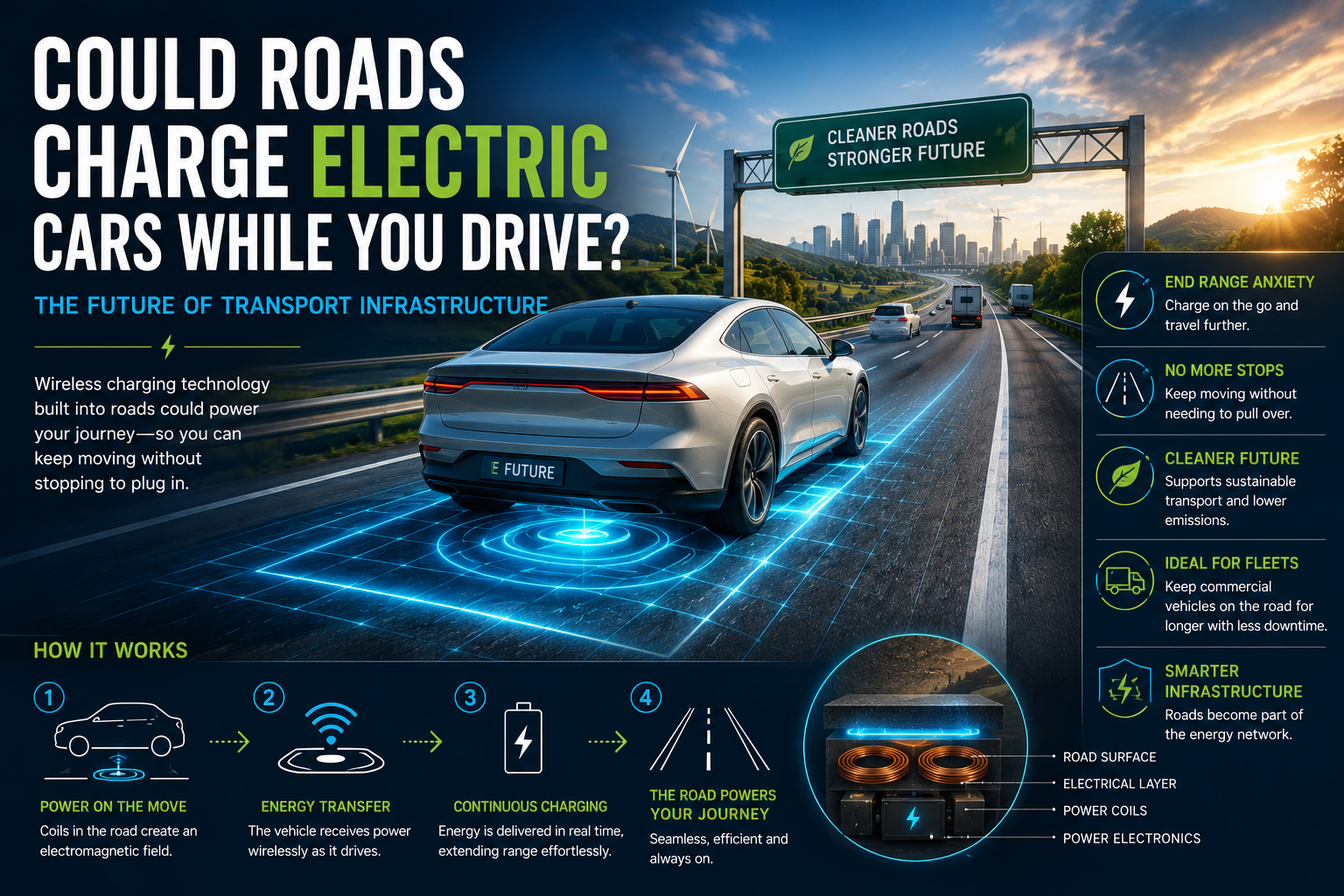
The Future of Transport Infrastructure
Imagine setting off on a long road trip without ever needing to stop and recharge your electric vehicle. There are no charging stations to search for, no queues during holiday periods and no need to plan your journey around battery range. Instead, your vehicle quietly charges as you drive, turning the road beneath your tyres into one giant charging network.
It might sound like something from a science fiction movie, but engineers around the world are already working to make it a reality. As electric vehicles continue to reshape the automotive industry, the next major innovation may not be found inside the car at all. It could be built into the road itself.
Charging While You Drive
Today’s electric vehicles rely on charging stations, whether at home, at work or along major highways. While charging technology has improved dramatically over the past few years, it still requires drivers to stop, plug in and wait.
Dynamic wireless charging takes a completely different approach. Using electromagnetic coils embedded beneath the road surface, electricity can be transferred wirelessly to specially equipped vehicles as they travel overhead. Similar to the wireless charging pads many people already use for smartphones, the technology simply operates on a much larger scale.
As an electric vehicle drives along these specially equipped roads, it receives a continuous supply of power without ever needing to stop. The concept is remarkably simple. Instead of taking the car to the charger, you bring the charger to the car.
Why It Could Change Everything
One of the biggest concerns surrounding electric vehicles has always been range anxiety. Although modern EVs are capable of travelling impressive distances, many drivers still worry about running out of charge or finding an available charging station during long journeys.
If roads themselves could provide power, much of that concern could disappear. Vehicles may no longer need extremely large battery packs because they could recharge throughout the journey. Smaller batteries would reduce vehicle weight, improve efficiency and potentially lower manufacturing costs.
For commercial transport, the benefits could be even greater. Delivery vehicles, buses and freight trucks could remain on the road for longer periods while reducing downtime associated with charging. Instead of planning operations around charging schedules, fleets could simply keep moving.
Building the Roads of Tomorrow
Of course, transforming existing roads into charging infrastructure is no small task.
Installing wireless charging technology beneath highways and major transport routes would require significant investment, careful planning and years of construction. Governments, infrastructure providers and vehicle manufacturers would all need to work together to establish common standards and ensure compatibility across different vehicle brands.
The good news is that progress is already being made. Several countries have launched pilot projects to test dynamic charging technology under real-world conditions. Researchers are exploring how roads can safely deliver power to moving vehicles while maintaining efficiency, durability and reliability. While widespread adoption is still some years away, the concept has moved well beyond the drawing board.
More Than Just Electric Cars
The potential extends far beyond passenger vehicles.
Imagine electric buses charging throughout their daily routes, reducing the need for large battery packs. Picture freight trucks travelling hundreds of kilometres without stopping to recharge, helping goods move more efficiently across the country. Emergency vehicles, public transport and even autonomous vehicles could all benefit from continuous charging infrastructure.
As transport becomes increasingly connected and electrified, the road itself could become an active part of the energy network rather than simply a surface we drive on. It represents a fundamental shift in how we think about infrastructure.
The Challenges Ahead
Like any emerging technology, there are still obstacles to overcome. The cost of upgrading existing road networks would be substantial, and not every road would require this capability. It is far more likely that key freight corridors, major highways and high-traffic routes would be prioritised first.
Vehicle compatibility will also be essential. Manufacturers will need to adopt common charging standards so that drivers can benefit regardless of which electric vehicle they own.
There are also important questions around energy demand. Supplying electricity to thousands of moving vehicles simultaneously would require significant upgrades to power networks and careful management of electricity generation and distribution. These are complex challenges, but they are the kind of engineering problems that innovation has solved many times before.
Looking Ahead
History has shown that transport infrastructure evolves alongside the vehicles that use it. Roads were redesigned for motor cars. Service stations transformed long-distance travel. Electric vehicle charging networks are now reshaping highways around the world.
Dynamic wireless charging could be the next chapter in that evolution. Whether it becomes the global standard or simply supports key transport routes, the idea challenges us to think differently about the future of mobility. Instead of asking how far a battery can take us, we may soon begin asking whether we need to stop charging at all.
If that future becomes reality, roads will no longer be passive pieces of infrastructure. They will become intelligent energy networks, quietly powering the journey beneath every passing vehicle. And perhaps the most exciting part is that the future of electric vehicles may not depend on bigger batteries. It may depend on smarter roads.


