
What Replaces Them Next?
Let’s be honest. Passwords are becoming a problem.
Every platform seems to want a different combination of letters, numbers and symbols. Some require regular updates, others refuse passwords that are too similar to previous ones and almost everyone has experienced the frustration of forgetting one at the worst possible moment.
For years, passwords have been the foundation of digital security. But as our lives become increasingly connected, they are starting to show their age. In a world filled with online banking, cloud platforms, mobile apps and connected devices, relying on people to remember dozens of complex passwords is no longer a sustainable solution.
That is why the future of digital security is beginning to move in a completely different direction.
The Password Was Built for a Different Era
When passwords first became common, the internet was a much simpler place. Most people only had a small number of online accounts and cyber threats were far less sophisticated than they are today.
Fast forward to now and the average person may have hundreds of digital logins across work, entertainment, shopping, banking and social media. As a result, many people reuse passwords, create simpler ones or store them in places that are not secure.
Unfortunately, cybercriminals understand this very well. Despite all the security rules and password requirements, traditional passwords remain one of the weakest links in digital protection. The reality is that passwords depend heavily on human behaviour and humans are not always predictable.
The Future is Becoming More Personal
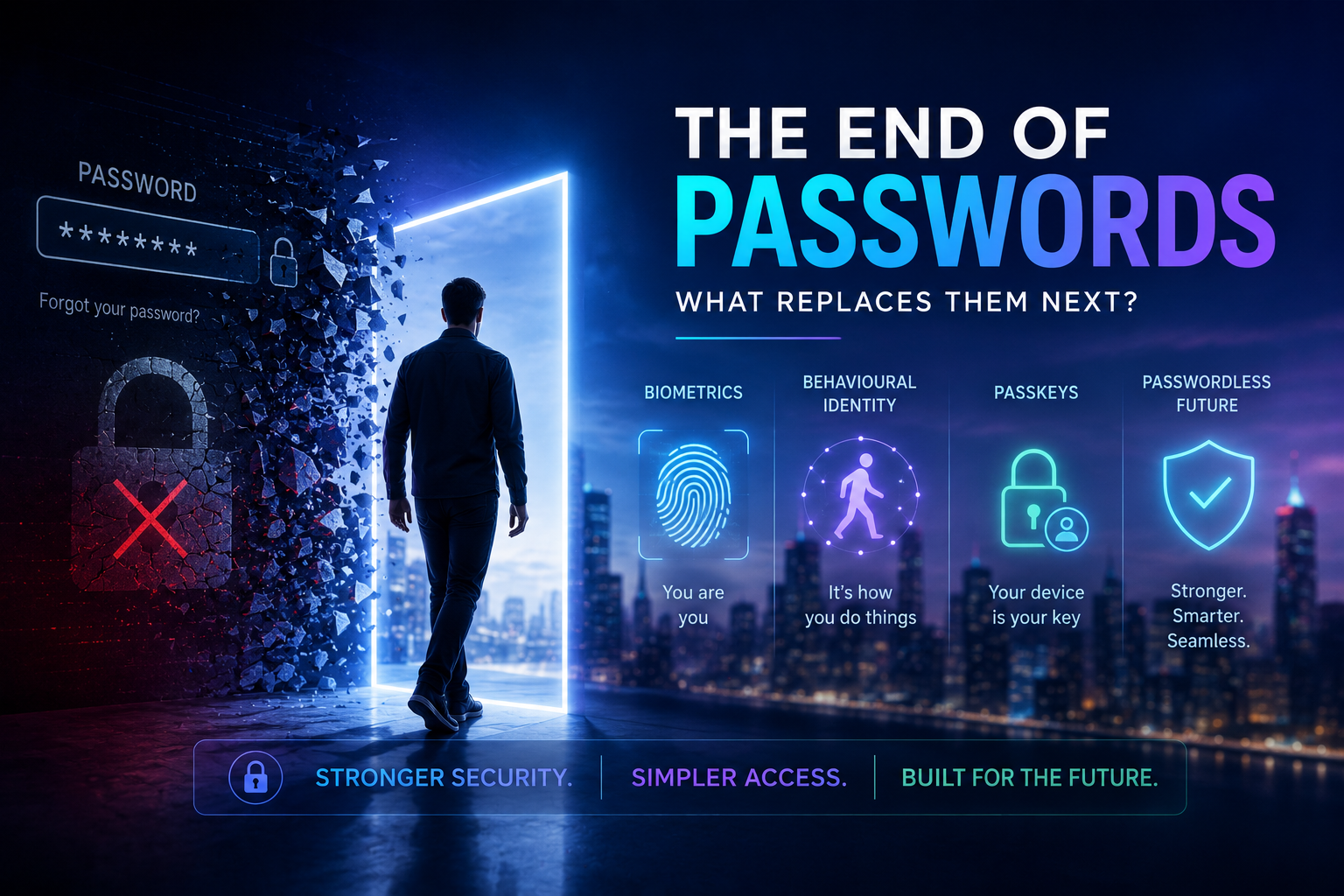
The next generation of digital security is shifting away from asking “What do you know?” and moving toward “Who are you?”. This is where technologies like biometrics, behavioural identification and passkeys are starting to reshape how we access systems and devices.
Most people are already familiar with biometrics, even if they do not think about it often. Unlocking a phone with a fingerprint or facial recognition has become second nature. It is quick, convenient and removes the need to constantly type passwords throughout the day. The appeal is obvious. A fingerprint cannot easily be guessed or forgotten in the same way a password can.
But biometrics are only the beginning.
Your Behaviour Could Become Your Identity
One of the most fascinating developments in digital security is behavioural identification. Rather than relying on a single password or scan, systems are beginning to analyse patterns in how people interact with technology. The way you type, how quickly you move your mouse, the angle you hold your phone or even the rhythm of your touchscreen movements can all become part of your digital identity.
Individually, these signals may seem insignificant. Together, they create a surprisingly accurate picture of what “normal” behaviour looks like for a user. If something suddenly changes, security systems can detect it almost instantly.
In many ways, the future of security may become almost invisible. Instead of stopping users with constant login screens and verification requests, systems will quietly monitor behaviour in the background to determine whether access appears legitimate.
The Rise of Passkeys
Another major shift already gaining momentum is the rise of passkeys. Technology companies including Apple, Google and Microsoft are pushing toward password free authentication systems that rely on trusted devices rather than memorised credentials.
With passkeys, authentication happens securely between your devices without storing traditional passwords that can be stolen through phishing attacks or data breaches. Put simply, your phone or laptop effectively becomes your key. The experience is faster for users while also being significantly more secure.
Why This Matters Beyond Personal Devices
This shift is not just important for smartphones and social media accounts. It has much broader implications across industries. As businesses become more connected and operations become increasingly digital, secure access becomes more critical than ever. Warehouses, airports, hospitals and transport networks now rely heavily on digital systems, mobile devices and cloud platforms to operate efficiently.
At the same time, the number of cyber threats continues to grow. The challenge for businesses is finding ways to strengthen security without slowing people down. Strong security systems that are frustrating to use often create new problems of their own. That is why the industry is moving toward solutions that are both more secure and more seamless.
The Challenges Still Ahead
Of course, the move away from passwords also introduces new questions.
Biometric systems raise concerns around privacy and data protection. Behavioural monitoring introduces ethical considerations around how much information technology should collect about users. Even passkeys, while more secure, will require widespread adoption before they become truly universal.
No system will ever be completely immune from attack. But the direction is clear. The future of digital security is becoming less about memorising information and more about intelligent systems understanding who we are.
Looking Ahead
The password has been part of digital life for decades, but its dominance may finally be coming to an end. Over the next several years, logging in could become almost invisible. Instead of typing passwords and answering security questions, authentication may happen quietly in the background through trusted devices, biometrics and behavioural signals.
The future of security is becoming smarter, faster and far more intuitive and in a strange twist, the best password of the future may be no password at all.


