
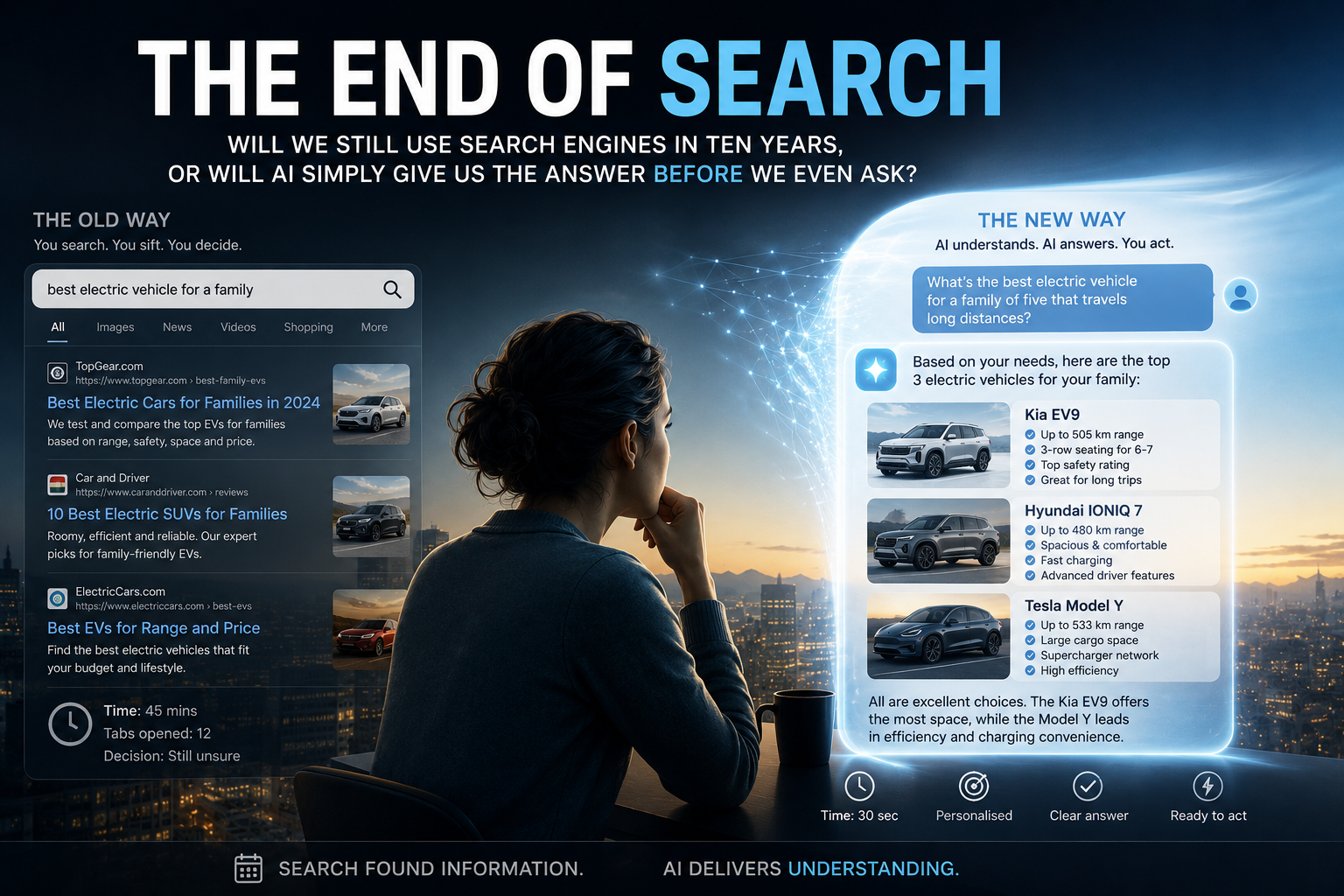
Will We Still Use Search Engines in Ten Years?
Think back to the last time you needed an answer.
Perhaps you wanted to know the best restaurant nearby, how to fix a problem at work or whether a particular product was worth buying. Chances are, you opened a search engine, typed in a few keywords and clicked through several websites until you found what you were looking for.
For more than two decades, this has been the default way we interact with information online. But what if that is about to change? With the rapid rise of artificial intelligence, many experts are beginning to ask an intriguing question: are we witnessing the beginning of the end of traditional search?
Search Has Barely Changed in Twenty Years
Despite incredible advances in technology, the basic concept of search has remained remarkably consistent. You enter a query. A search engine scans billions of webpages. You are presented with a list of links. Then the real work begins as you compare websites, evaluate sources and piece together the answer yourself. Search engines have become exceptionally good at finding information, but they still largely operate as directories. They point you in the right direction rather than delivering the complete answer.
AI is changing that.
Instead of presenting a list of links, AI systems are increasingly able to understand questions, gather information from multiple sources and provide a direct, conversational response. Rather than searching for information, we are starting to have conversations with it.
From Search Engines to Answer Engines
The shift is already underway.
AI assistants can now summarise articles, explain complex topics, compare products, draft content and answer detailed questions in seconds. Rather than opening ten browser tabs, users can often receive a single, comprehensive response. This represents a fundamental change in how people access knowledge.
Imagine asking, “What is the best electric vehicle for a family of five that regularly travels long distances?” Instead of scrolling through dozens of reviews, an AI assistant could analyse your requirements, compare multiple vehicles and provide recommendations tailored specifically to your needs. The experience becomes less about searching and more about solving. For users, that is incredibly powerful.
The Search Box May Disappear Altogether
Perhaps the biggest change is that search may become invisible. Today, we actively seek information by opening browsers and typing queries. In the future, information could simply appear when we need it. Your car might suggest charging locations before your battery runs low. Your calendar may automatically recommend the best travel route based on traffic conditions. Your workplace systems could surface relevant documents before a meeting even begins.
In many cases, AI may anticipate our needs before we explicitly ask. This is known as proactive intelligence, and it could dramatically reshape our relationship with technology. The future may not involve searching for information at all. Information may simply find us.
What Does This Mean for Businesses?
For organisations, this shift presents both opportunities and challenges. Businesses have spent years optimising websites for search engines. Entire industries have been built around search rankings and online visibility. If users increasingly rely on AI generated answers rather than lists of links, companies may need to rethink how they engage with customers online. The focus could shift from simply ranking highly on search engines to becoming trusted, authoritative sources that AI systems choose to reference. Content quality, expertise and credibility may become even more important than they are today. In short, businesses may need to optimise not just for search engines, but for AI itself.
Will Traditional Search Disappear Completely?
Probably not. There will always be situations where people want to explore information for themselves, compare multiple viewpoints or conduct detailed research. Traditional search remains extremely valuable for discovery and investigation.
However, the way we search is almost certain to evolve. History shows that new technologies rarely eliminate old ones overnight. Instead, they reshape how we use them. Television did not replace radio. Streaming did not completely eliminate cinemas. Similarly, AI is unlikely to replace search entirely. It will simply transform it.
Looking Ahead
Ten years from now, opening a browser and typing keywords into a search bar may feel as old-fashioned as using a paper map. The next generation may grow up expecting technology to understand context, anticipate needs and provide answers instantly. Search will become more conversational, more personalised and far more intelligent. The real question may not be whether search engines survive. It may be whether we continue to think of searching as something we consciously do at all.
Because in the age of AI, the future of search may not be search. It may simply be understanding.


