
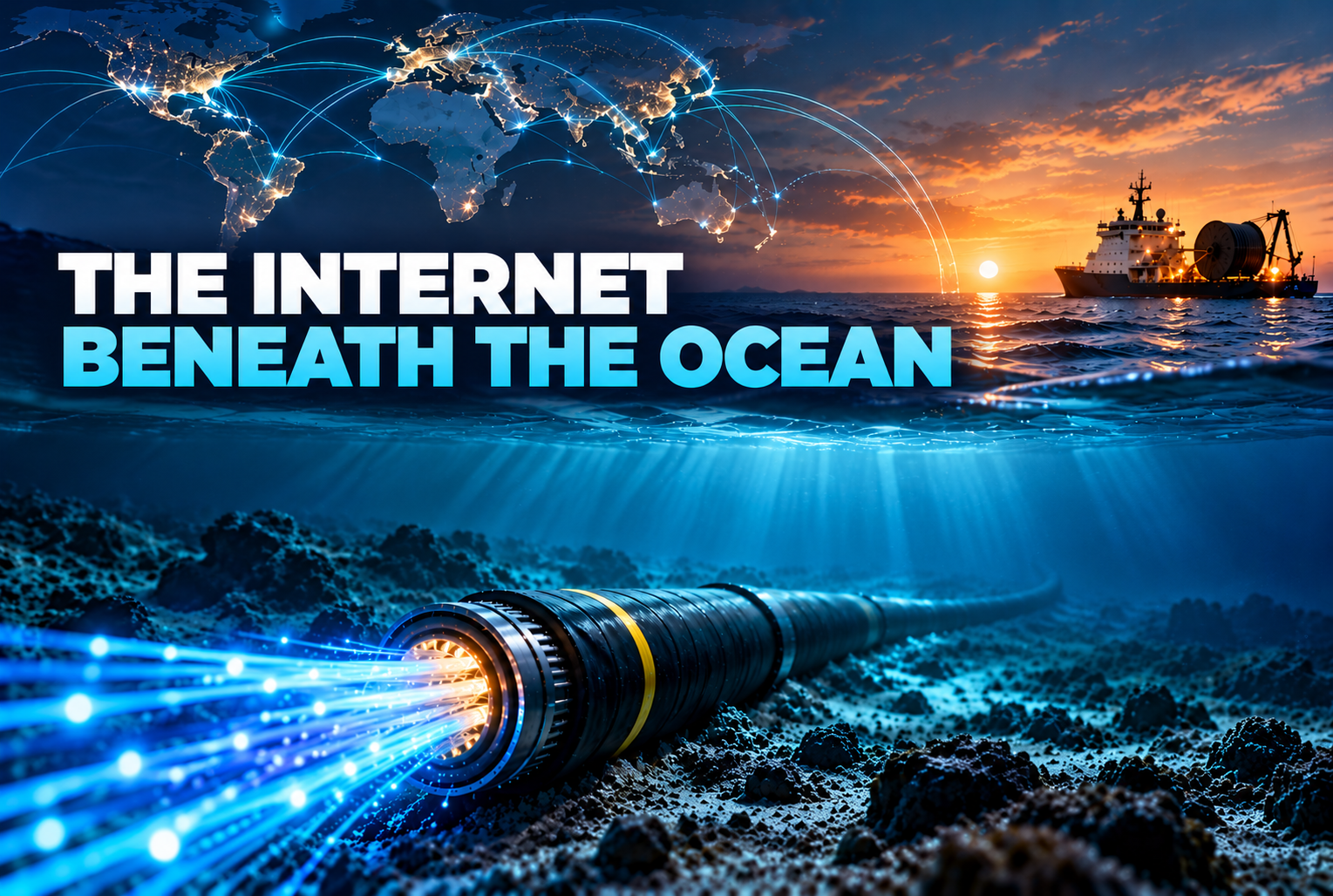
When you send a message overseas, stream a movie or make an international video call, have you ever wondered how that information actually travels around the world?
Most of us probably imagine satellites orbiting Earth, bouncing signals between continents. After all, that’s what we’ve seen in countless movies. But the reality is far more surprising.
Deep beneath the ocean, thousands of kilometres of cables are quietly carrying the vast majority of the world’s intercontinental data. These cables form one of the most important pieces of infrastructure on the planet, yet most people don’t even know they’re there.
The Internet’s Underwater Highway
Believe it or not, around 99% of intercontinental data traffic travels through submarine cables, rather than satellites.
These cables stretch across oceans, connecting countries and continents through an enormous underwater network. Together, the world’s submarine telecommunications cables span more than 1.4 million kilometres, enough to wrap around the Earth more than 35 times!
And despite carrying enormous amounts of information, some of these cables are surprisingly thin. Modern submarine cables can be roughly the diameter of a garden hose, although their thickness varies depending on where they’re installed.
Inside them are tiny strands of optical fibre that transmit information using pulses of light. These signals travel at extraordinary speeds, allowing everything from international financial transactions to video calls to happen almost instantaneously.
How Do You Lay a Cable Across an Ocean?
Installing an underwater internet cable is no small task.
Specialised ships carry enormous lengths of cable and carefully lay them along predetermined routes across the seabed. Before installation, engineers survey the ocean floor to avoid hazards such as underwater mountains, steep slopes and areas prone to earthquakes.
In shallower waters, cables are often buried beneath the seabed to protect them from fishing equipment and ship anchors. In deeper waters, they typically rest directly on the ocean floor, sometimes several kilometres below the surface.
A single cable system can take years to plan, manufacture and install, with projects often costing hundreds of millions of dollars. All that effort just so we can send memes to someone on the other side of the world!
What Happens When a Cable Breaks?
Here’s where things get particularly interesting.
Despite their importance, underwater cables are surprisingly vulnerable. Fishing activities, ship anchors, natural disasters and equipment failures can all cause damage. In fact, submarine cable faults happen regularly around the world.
When a cable is damaged, internet traffic can often be redirected through other routes. However, regions with fewer connections may experience slower speeds or significant disruptions.
Repairing a damaged cable is an extraordinary operation. Specialist ships must locate the fault, retrieve the damaged section from the ocean floor, splice in a replacement and carefully lower the repaired cable back into position. Depending on the location, weather conditions and availability of repair vessels, the process can take days or even weeks. Imagine trying to repair a fibre-optic cable thousands of metres underwater!
Why Don’t We Just Use Satellites?
With companies launching thousands of satellites into orbit, you might wonder why we still rely on cables lying at the bottom of the ocean. The answer comes down to capacity, cost and performance.
Fibre-optic cables can carry enormous volumes of data with relatively low latency, making them ideal for connecting major population centres and supporting global internet infrastructure.
Satellites, particularly newer low-Earth-orbit systems, are incredibly useful for reaching remote communities, ships, aircraft and areas without reliable terrestrial connections. However, they generally cannot match the total capacity and economics of major submarine cable routes.
Rather than replacing underwater cables, satellites provide an important complementary way to keep the world connected.
The Invisible Infrastructure We Depend On
The next time you watch a video from another country, join an international meeting or send a message to someone overseas, there’s a good chance your data will travel through a cable resting on the ocean floor.
It’s remarkable to think that so much of our modern world depends on infrastructure hidden beneath the waves. And as artificial intelligence, cloud computing and global connectivity continue to expand, demand for these underwater connections will only grow.
The internet might feel wireless, but some of its most important connections are lying at the bottom of the ocean.
Sometimes, the technology that changes the world is the technology we never see.


