
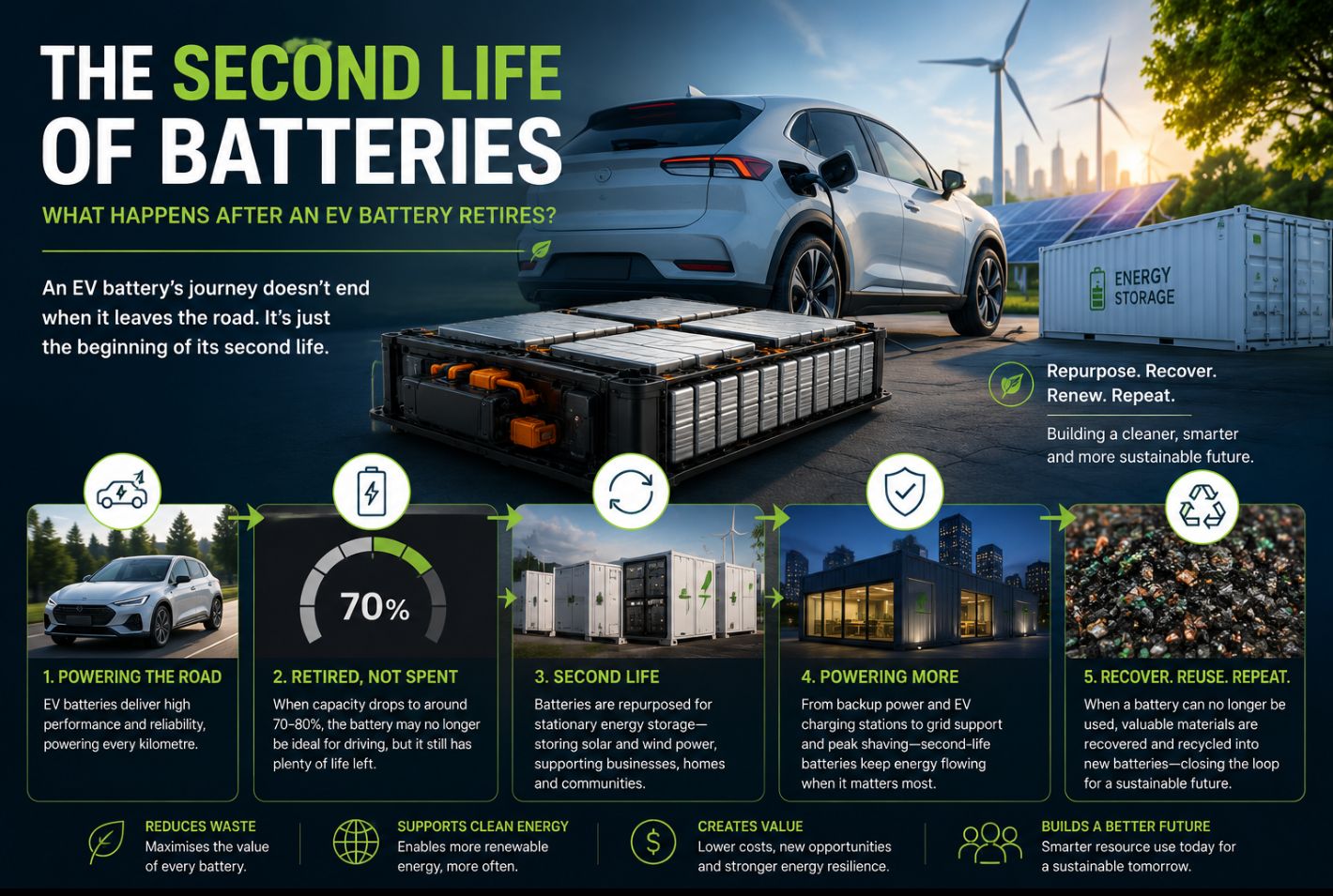
What Happens After an EV Battery Retires?
Electric vehicles are becoming an increasingly common sight on our roads. Every year, more drivers are making the switch, attracted by lower running costs, quieter driving and a reduced environmental footprint. As this transition accelerates, however, an interesting question is beginning to emerge. What actually happens when an electric vehicle battery reaches the end of its life?
The answer is not as straightforward as many people think. Unlike the batteries in our phones or laptops, an EV battery’s journey rarely ends when it is removed from a vehicle. In many cases, it is simply moving into a new role, one that could continue delivering value for many years to come.
Retirement Doesn’t Mean the Battery Has Failed
When people hear that an EV battery has reached the end of its life, it often sounds as though it has stopped working completely. In reality, that is rarely the case.
Most electric vehicle batteries are replaced when their capacity drops to around 70 to 80 per cent of their original performance. At this point, the battery may no longer provide the driving range expected by vehicle owners, but it still has a significant amount of usable energy storage remaining.
A good way to think about it is like a professional athlete retiring from elite competition. They may no longer compete at the highest level, but they still have plenty to offer. The same principle applies to many EV batteries.
A New Purpose Beyond the Road
Rather than being discarded, retired EV batteries are increasingly being repurposed for less demanding applications, and some of the possibilities are surprisingly exciting.
One of the most common uses is stationary energy storage. Instead of powering a vehicle, these batteries can be connected together to store electricity generated from solar panels or wind farms. That stored energy can then be used later when demand increases, during peak usage periods or after the sun goes down.
This approach not only extends the life of the battery but also helps improve the reliability of renewable energy while reducing waste. Around the world, second-life batteries are already supporting homes, businesses, schools, shopping centres and even electricity networks.
Powering More Than Just Cars
The opportunities continue to grow as the technology evolves. Repurposed EV batteries are now being used to provide backup power during outages, support electric vehicle charging infrastructure, stabilise electricity grids and reduce pressure during periods of peak demand.
For businesses, this can mean lower energy costs and greater resilience. For communities, it creates new opportunities to improve energy security while making better use of renewable resources.
It is a great example of how innovation is not always about inventing something new. Sometimes it is about discovering new ways to use what we already have.
When a Battery Finally Reaches the End
Eventually, every battery reaches the point where it can no longer be reused. Even then, its story does not necessarily end.
Modern EV batteries contain valuable materials such as lithium, nickel, cobalt, copper and graphite. Rather than allowing these resources to end up in landfill, specialised recycling facilities can recover many of these materials so they can be used again in the production of new batteries.
As recycling technology continues to improve, the industry is moving closer to a true circular economy, where valuable materials remain in use for as long as possible instead of being discarded after a single lifecycle.
Why It Matters
As millions of electric vehicles enter the market over the coming decades, battery lifecycle management will become just as important as the vehicles themselves.
The future of sustainable transport is not simply about replacing petrol with electricity. It is about designing smarter systems that maximise resources, minimise waste and continue creating value long after a product’s original purpose has ended.
Second-life batteries perfectly demonstrate this way of thinking. Rather than viewing retirement as the end, the industry is increasingly seeing it as an opportunity for renewal.
Looking Ahead
The electric vehicle revolution is reshaping far more than the automotive industry. It is changing the way we think about energy, sustainability and the lifecycle of technology itself.
Tomorrow’s batteries may spend a decade powering a family vehicle before supporting a solar-powered business, stabilising an electricity grid or storing renewable energy for an entire community. Eventually, the valuable materials inside those batteries may be recovered and transformed into the next generation of energy storage.
What was once considered waste is rapidly becoming one of the world’s most valuable resources.
Perhaps that is the most remarkable part of the story. For an EV battery, retirement is not the end of the journey. It is simply the beginning of its second life.


