
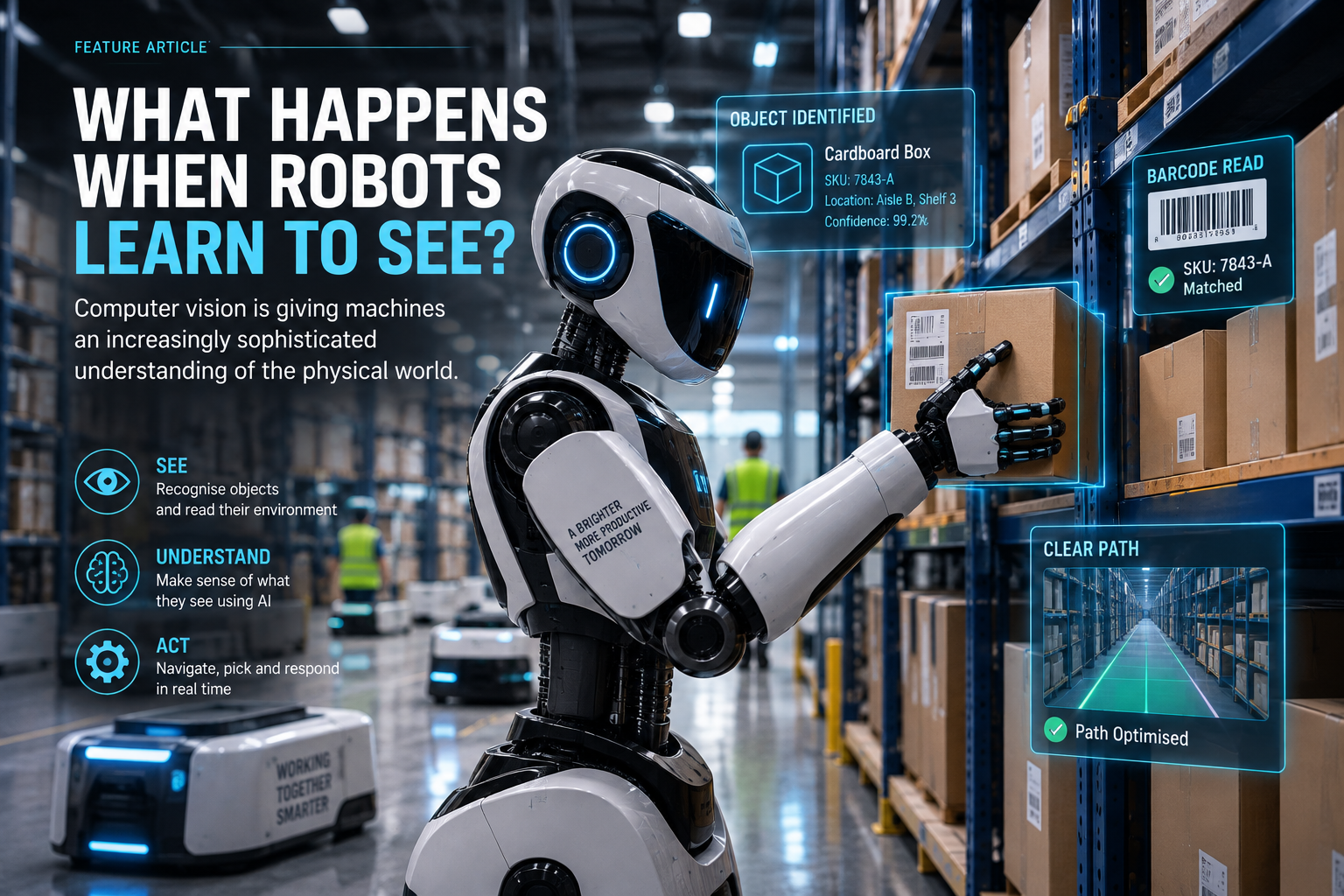
From machines that follow instructions to machines that understand the world around them.
Imagine walking into a warehouse where robots move effortlessly between shelves, identify products, navigate around obstacles and pick up items without needing someone to tell them exactly where everything is. A box falls onto the floor, and instead of blindly continuing along its programmed route, a robot notices it, slows down and finds another way around.
It might sound like something from a science fiction movie, but this is the direction robotics is heading, thanks to a technology called computer vision.
For decades, robots have been incredibly good at performing repetitive tasks. Give them a precise set of instructions in a controlled environment, and they can repeat the same movement thousands of times with remarkable accuracy. However, introduce something unexpected, such as a misplaced box, an unfamiliar object or a person walking into their path, and traditional robots can struggle.
Now, machines are learning to do something that humans take for granted every day. They’re learning to see.
Giving Robots a Pair of Eyes
Computer vision allows machines to interpret visual information from cameras and other sensors. Rather than simply recording images, robots can use AI to identify objects, recognise patterns, estimate distances and understand aspects of their surroundings.
Think about how effortlessly you recognise a coffee cup sitting on your desk. You can identify it, work out where it is and reach for it without needing to calculate every movement consciously.
For a robot, that seemingly simple task is surprisingly complicated. It needs to distinguish the cup from the background, determine its position, estimate its shape and decide how to pick it up without dropping it.
Computer vision helps make this possible. Combined with AI, depth sensors and advanced robotics, it allows machines to move beyond simply following instructions and begin responding to what they encounter.
The Warehouse That Watches Itself
Warehouses are particularly interesting environments for this technology because they’re constantly changing. Products arrive, shelves are replenished, pallets move and workers travel between different areas throughout the day.
Traditionally, many automated systems have relied on fixed routes, carefully arranged products or predictable operating conditions. Computer vision opens the door to more flexible automation.
Imagine a robot travelling through a warehouse to collect an order. Using cameras and sensors, it could identify the correct product, determine its location and guide a robotic arm to pick it up. If an item has been placed slightly differently than expected, the system could adjust its approach rather than requiring someone to reposition it.
Vision-enabled robots can also inspect products for damage, identify incorrectly positioned items and help monitor stock levels. Instead of relying entirely on predetermined instructions, they can use visual information to make decisions based on what is actually happening around them.
The result could be a warehouse where automation becomes increasingly adaptable to the unpredictable nature of everyday operations.
What Happens When Robots Encounter the Unexpected?
Perhaps the most exciting development is the ability for robots to respond to situations they haven’t encountered in exactly the same way before.
Consider an autonomous mobile robot travelling through a busy distribution centre. Its planned route is suddenly blocked by a pallet that wasn’t there a few minutes earlier.
A conventional automated system might stop and wait for assistance. A more advanced vision-enabled robot could recognise the obstacle, assess the available space and calculate an alternative route, provided its navigation and safety systems allow it to do so.
This ability to perceive and respond to changing surroundings is helping robots move beyond tightly controlled environments into more complex workplaces.
However, recognising an object is not the same as understanding every possible situation. Robots can still misinterpret visual information, struggle with unfamiliar conditions or encounter scenarios that require human judgement. Reliable safety systems and human oversight remain essential, particularly when robots operate alongside people.
From Warehouses to the Wider World
The possibilities extend far beyond logistics and manufacturing.
In agriculture, vision-enabled robots can identify ripe fruit, monitor crop health and distinguish weeds from valuable plants. In hospitals, robotic systems can assist with transporting supplies and navigating busy corridors. In manufacturing, computer vision can help detect defects that might be difficult to identify during routine inspections.
Even our homes could eventually become more accessible to robots capable of recognising everyday objects and interacting with their surroundings.
Imagine a household robot that can locate your missing keys, collect laundry or recognise that someone has left a glass on the edge of a table. These tasks sound simple to us, but they require a remarkable combination of visual recognition, spatial awareness and physical coordination.
As these capabilities improve, robots could become increasingly useful in environments that are too unpredictable for traditional automation.
The Future Is Looking Interesting
For years, the biggest advantage of robots has been their ability to perform repetitive tasks with speed and consistency. Computer vision is helping add another capability: the ability to observe the world and adapt their behaviour accordingly.
The next generation of robots may not need every object to be placed in exactly the right position or every environment to remain perfectly organised. Instead, they could become more flexible, working alongside people and responding to changing conditions in real time.
There is still a long way to go before robots can match the visual understanding and common sense of humans. But as AI, sensors and robotics continue to develop together, the gap between machines that simply follow instructions and machines that can interact intelligently with their surroundings is beginning to narrow.
The future of robotics may not be defined by how fast a machine can move or how much weight it can lift. It may be defined by how well it can understand the world around it.
And once robots can truly see what they’re doing, the possibilities become much more interesting.


