
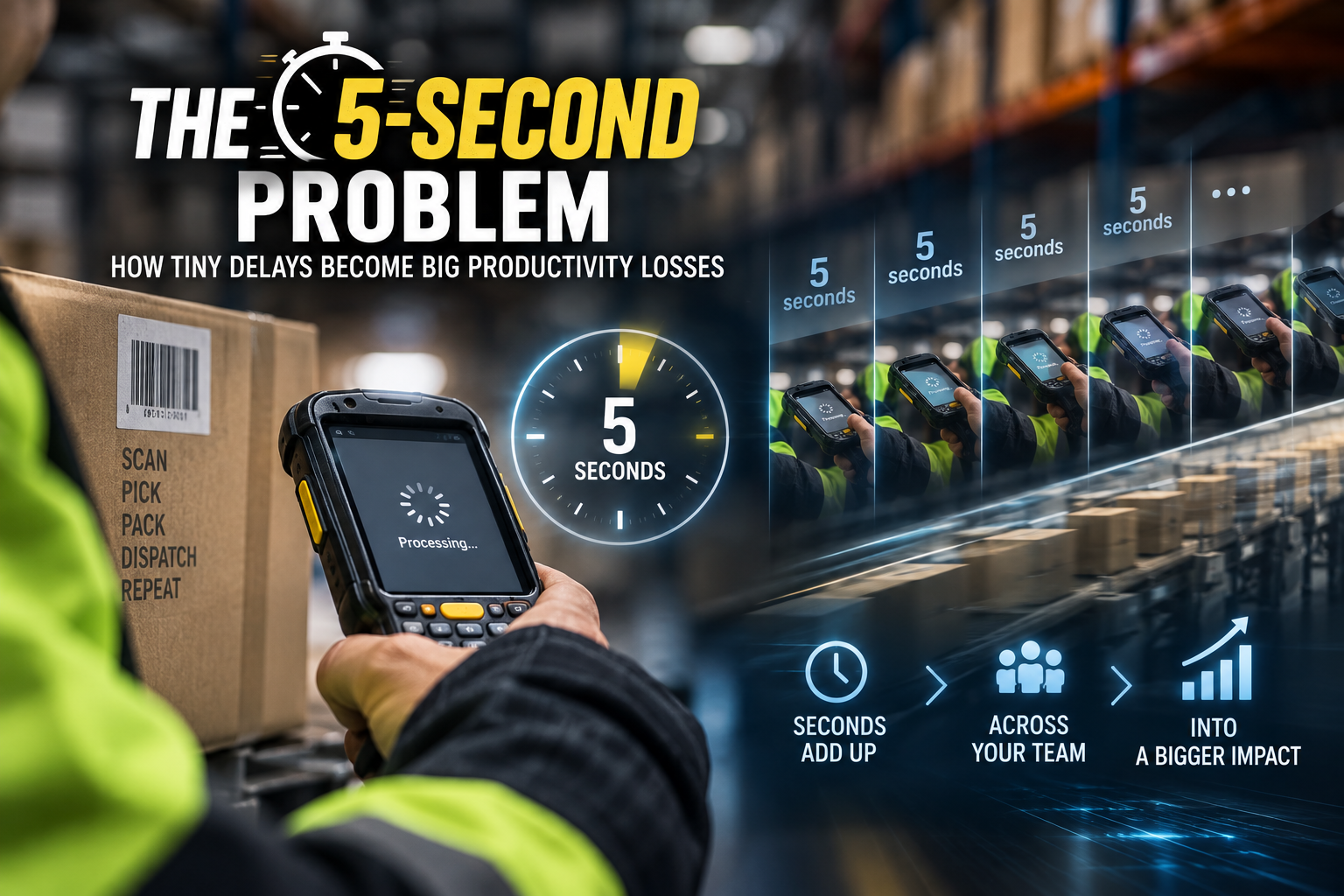
Five seconds doesn’t sound like much. Until you multiply it by an entire workforce.
Imagine a warehouse worker scanning a barcode. The device takes five seconds longer than it should to process the information. No big deal, right? It’s barely enough time to take a sip of coffee.
Now imagine that same delay happening hundreds of times throughout the day, across dozens of workers, every single shift. Suddenly, those seemingly insignificant seconds begin adding up to hours of lost productivity.
This is the 5-second problem, and it highlights something businesses often overlook: operational inefficiency doesn’t always arrive as a major breakdown. Sometimes, it quietly builds up through thousands of tiny interruptions that nobody thinks to question.
The Maths Behind Five Seconds
Let’s put those five seconds into perspective. Consider a distribution centre with 50 workers, each completing 200 scanning tasks per day. If every scan takes just five seconds longer than necessary, the operation loses a combined 50,000 seconds every day.
That’s almost 14 hours of working time lost daily, simply waiting for devices to respond.
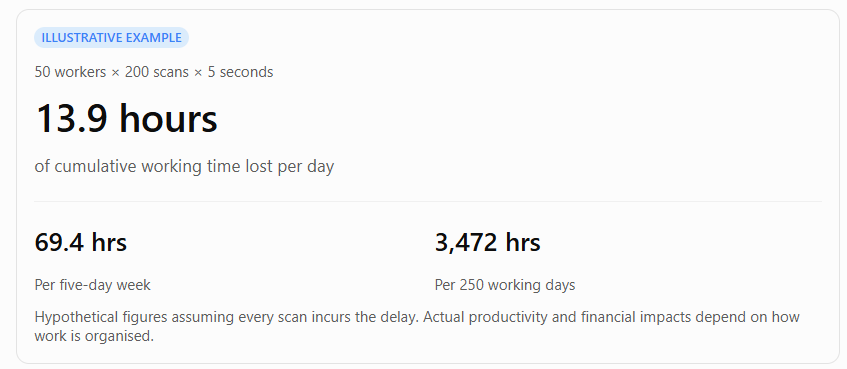
Of course, not every second of waiting translates directly into lost revenue. Workers may complete other tasks during delays, and some processes have natural downtime. Nevertheless, the example demonstrates how even a small, repeated inefficiency can consume a surprising amount of operational time.
It’s Not Just About Scanning
The same principle applies to almost every part of a modern operation. A mobile computer takes longer to load an application. A printer pauses before producing a label. A wireless connection drops, forcing an employee to reconnect. A worker needs to restart a device halfway through a shift.
Individually, these frustrations might not seem worth reporting. Employees often develop workarounds, accept slower performance as normal or simply assume that technology is supposed to behave that way.
The problem is that these delays rarely exist in isolation. A slow device can hold up picking, which delays packing, which affects dispatch. A minor interruption at one stage of the workflow can create additional pressure elsewhere, particularly during peak operating periods.
Over time, the cost extends beyond lost minutes. It can affect employee satisfaction, customer service, order accuracy and the ability to meet demanding operational targets.
When Did Slow Become Normal?
One of the biggest challenges is recognising inefficiency when it has become part of everyday work.
If an application has always taken ten seconds to load, employees may not realise it could take two. If a device regularly loses connectivity in a particular aisle, workers might simply avoid that area or wait until the connection returns.
These habits can make underlying technology problems surprisingly difficult to identify. Everything appears to be working, orders are still being processed and the operation continues moving. Yet there may be significant opportunities to improve performance hiding in plain sight.
This is why understanding how technology performs in the real world matters just as much as understanding its specifications. Reviewing device performance, wireless coverage, application response times and employee feedback can help businesses identify where unnecessary delays are occurring.
Sometimes, the most valuable operational insight comes from asking a frontline worker a simple question: “What slows you down every day?”
Getting Those Five Seconds Back
Solving the 5-second problem doesn’t necessarily mean replacing every device or investing in an entirely new system. The right solution depends on understanding what is causing the delay in the first place.
It might involve improving wireless connectivity, updating software, optimising workflows, refreshing ageing devices or introducing better device management and maintenance practices. In some cases, a relatively small change can remove an interruption that has affected thousands of tasks.
At Gamma Solutions, we believe technology should help people work more efficiently, not create additional obstacles. By looking beyond individual devices and considering how hardware, software, wireless infrastructure and support work together, businesses can identify opportunities to improve performance across their operations.
The Bigger Picture
Five seconds might not seem like a reason to rethink your technology strategy. But when those seconds are repeated across an entire workforce, they can reveal a much bigger opportunity.
The most significant productivity improvements don’t always come from major investments or dramatic changes. Sometimes, they come from removing the small frustrations that have quietly become part of the working day.
Because when you give people five seconds back, thousands of times a day, you’re not just making technology faster. You’re giving your operation more time to do what matters.


